
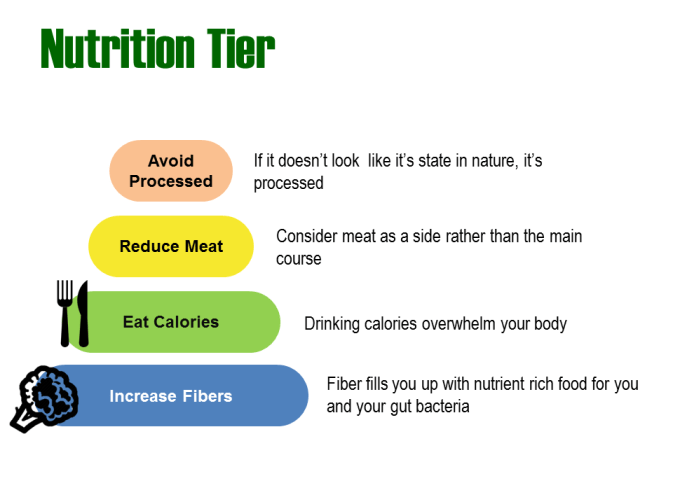
Welcome to the Nutrition Tier.
You hold the power to choose your level of healthy.
If you are looking to improve or maintain your health, simply choose which level of healthy you want to achieve.
Start at the bottom of the Tier and incorporate as often as possible.
Continue moving upwards to further improve your health.
Once you master all four levels in the Nutrition Tier, you will be in the most simple position to achieve your health and wellness goals.
Level 1: Increase Fibers
Americans as a whole do not consume enough fiber. Increasing the amount of foods with fibers you eat at each meal is the first step toward improving your health.
Why is fiber good?
First, most foods with fiber are fruits and vegetables that are packed with nutrients that support optimal health.
Second, eating more foods with fiber will help crowd out other more processed foods.
Fiber can help you feel more full which will decrease the amount of food you can or want to eat.
Lastly, your gut is filled with bacteria that love to eat foods with fiber. By feeding them what they want, these bacteria in turn support a healthy gut, a healthy immune system, and a healthy mind. A brief background video on gut bacteria can be found here.
What should I do?
- Eat more whole fruits, vegetables, leafy greens, lentils, and beans
- Make healthy switches:
- Wheat flour to buckwheat flour
- Fried chips to carrots/celery with hummus or salsa
- Instant oatmeal to regular oats
- Iceberg lettuce to spinach, kale or mixed greens
- Lightly cook vegetables, they should not be too mushy
- Incorporate a salad before or after most meals
- Avoid food juicers—they waste all the good fiber!
Level 2: Eat your calories
Eat your calories is another way of saying don’t drink your calories through juice, soda, alcohol, etc. Instead eat foods that contain some fiber that force you to spend some time chewing.
Why should I eat my calories?
It is much easier and quicker to drink than it is to eat but our bodies are best adapted to take in calories slowly. When you consume drinks with no fiber or fat (both slow absorption), you flood your intestines with calories and sugars that cannot be processed fast enough. This causes spikes in blood sugar and insulin, which can cause crashes later and a feeling of even more hunger. Additionally, most drinks contain more sugar than what is recommended with little-to-no nutritional content.
What should I do?
- Avoid sugary drinks. Diet drinks are not the answer either. Instead try sparkling water with a squirt of lemon or lime for flavor.
- If you normally juice your fruits and veggies, instead blend them up. At least you’ll still get some fiber.
- If you do drink calories, take your time. Slowly sip the beverage to give your body a chance to keep up with the flood of calories.
Level 3: Reduce meat
The third step to improving your health is to reduce the amount of meat you consume. This includes lean and red meats but with a greater focus on reducing red meats. Of particular concern is processed meats that are cured or contain nitrates/nitrites—definitely avoid these.
Why should I reduce meat?
The body of evidence overwhelmingly suggests that eating too much meat is not good for your health and may increase your risk of cancer. I discuss this in a past blog post but to summarize briefly, the World Health Organization, the United States Dietary Guidelines Advisory Committee, and studies from the longest living people on earth suggest that limited amounts of meat is the way to go to reduce your risk of disease and improve your health.
What should I do:
- Avoid eating meat every day
- Supplement meat with other sources of fat and protein, including fish, nuts, seeds, lentils, beans, eggs, and whole dairy
- When meat is consumed it should be as a side, not the main course
- Eat red meat once per week at most
- Choose pasture raised, organic meats
- Limit burning or charring meat. This can create more carcinogenic chemicals.
Level 4: Avoid processed
To achieve the highest and final level, avoid processed foods. From a basic perspective, this means to avoid foods that have been refined, contain artificial ingredients or preservatives. But to an even deeper level, all food that comes in a package has been processed. Foods that haven’t been processed are found in the produce section at the grocery store or at your local farmers market.
Why should I avoid processed foods?
While processed foods provide convenience, they usually lack nutrients and contain too much sugar. Additionally, these foods usually need chemicals to prevent bacterial growth and maintain their appearance. Here is renowned food expert, Michael Pollan to briefly explain:
What should I do?
- Eat whole foods found in the produce aisle or at your local farmers market
- Cook your own meals / make your own food
- Avoid foods with more than 5 ingredients
- Avoid foods with specific ingredients: hydrogenated oils, nitrates/nitrites, corn syrup
- If you can afford, eat more organic, in-season foods



 The Healthy Pharmacist