
Key Story Summary:
- Drug makers can set the price of their own drugs since there is no legislation controlling prices.
- Despite some negative opinions, drug companies advance science and reduce disease.
- To truly lower the burden on the healthcare system, a shift towards preventing disease is needed.
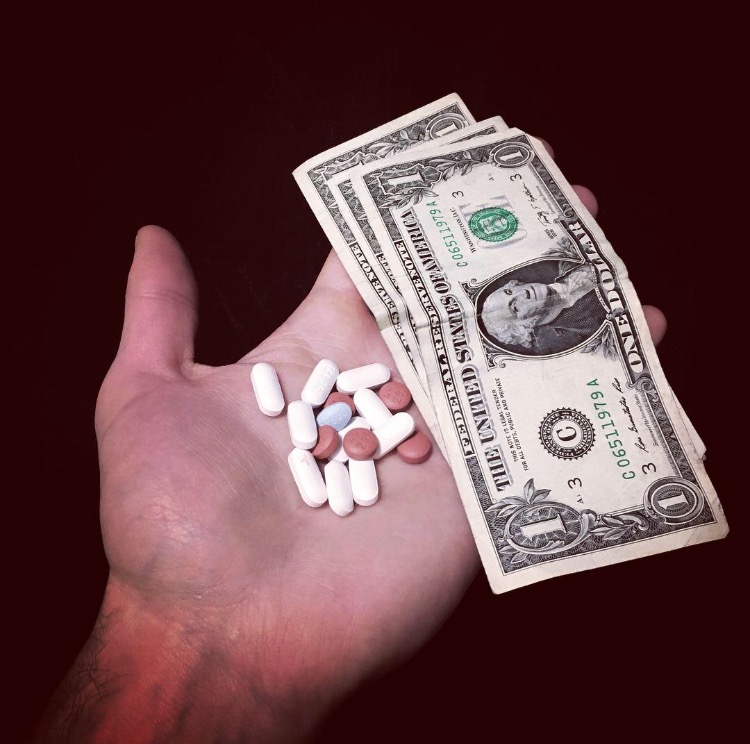
Does $1,000 sound like a lot of money for a single pill? What if you need to take this pill for 12 to 24 weeks for a total cost around $90,000? Now what if this pill were to cure your disease, allowing you never to have to worry about it again?
In this case, I am referring to Gilead’s hepatitis C drug, Harvoni, which has cure rates of up to 100%.
Most of the public and health insurance companies were outraged at the high cost of this pill, because 1.) it sounds really expensive and 2.) it would put too much of an economic strain on the healthcare system too quickly if people rushed to get treatment. Therefore, health insurance companies put strict limits on who could receive this life-changing therapy. (Listen to this NPR podcast for further discussions on this topic:)
http://www.npr.org/player/embed/465748256/465748257
Hepatitis C is a viral infection of the liver that can lead to liver failure and require patients to undergo a liver transplant which may come with an associated $550,000 of medical costs. If you also include loss productivity, these costs to our economy increase further.
With this in mind, it seems reasonable to charge someone $90,000 to prevent costs of almost $600,000 later in life, especially when you can cure the disease in a relatively short time span. The healthcare system would actually save money by fronting the $90,000.
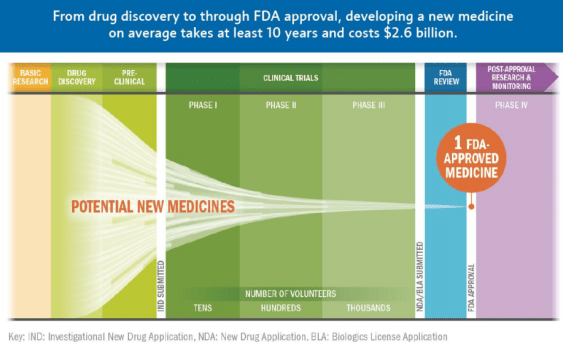
Calculating money saved by limiting long-term disease, like the case above, is one of the factors pharmaceutical companies use to set drug prices. Other factors used to set drug prices include calculating the costs of researching new drugs (including paying for the hundreds that fail, seen below), manufacturing drugs (including creating new technologies to streamline development/quality process), and paying for all the employees that promote the science of their medicine (including me).
As for the case with Harvoni, the actual drug did not cost $1,000 to make and instead represented a price that would maximize profits and provide cost savings from traditional therapies or standards of care (like hospital/clinic visits or other downstream sequelae), while also ensuring insurance companies would still pay for the high priced drug.
Sometimes to progress innovation though, high drug prices are justified. The more money a pharmaceutical company invests into researching new drugs, the more willing they’ll be to take risks, accept failure, and progress science. Some of the biggest discoveries in drug development occurred as a result of serendipity, rather than through calculated experimentation.
Since a drug company is not necessarily altruistic by nature and is instead a for-profit entity, they need to make money, make investors money, and make investors invest more money into their company.
In the past to increase profits, companies would go after diseases with large amounts of people with chronic conditions. That way they’d have huge populations of people continuously taking their drugs, indefinitely. Recently though, insurance companies are beginning to push back higher drug prices as more lower cost options become available.
Now, companies are focusing in more specialty diseases with smaller patient populations. By targeting smaller patient groups with more uncommon diseases, higher drug prices can be spread over a larger patient insurance pool, and not drastically affect overall insurance costs.
Unfortunately, there is nothing to stop drug companies from raising drug prices (not even competition necessarily, as we will see). Unlike most other countries which have a single-payer healthcare system, where one government entity can negotiate for drug prices, the United States relies on market competition as a means to control drug prices. In fact, Medicare in the US is legally prohibited from negotiating drug prices with pharmaceutical companies. With prices continuing to rise, it appears our free market approach to control prices doesn’t work.
Amidst growing calls to correct this situation, the White House may soon issue an executive order to control drug prices and presidential candidates have proposed their own plans to control prices.
Within the Democratic party, Sen. Bernie Sanders has stated, “The pharmaceutical industry has become a health hazard for the American people. The time is long overdue for Congress to listen to the needs of the American people and not the enormously profitable pharmaceutical industry.”
The needs of the people are to have affordable drugs and with increased competition within pharma, this should be occurring and driving down drug prices.
Ironically, one disease in particular has had consistent drug price increases despite greater competition.
Multiple sclerosis is an inflammatory disease of the nervous system and the first drug to treat the immune system’s attack on the body was approved in 1993. Since then, even the oldest and least effective drugs for this disease have continued to grow at an unsubstantiated and alarming rate. One drug that originally cost $8,700 now costs $62,400 a year.
While I really don’t know why this is occurring (neither do the authors of this paper), it is important to reiterate that pharmaceutical companies can increase prices as they see fit, driving up profits, within a healthcare system that does’t stop them.

To be fair, drug research and the pharmaceutical industry provide a great benefit to millions of people by providing medicines that can relieve suffering and prevent disease progression. These companies also progress our collective understanding of disease and create innovation in other areas such as in research techniques and manufacturing processes.
Even pseudo-health gurus wouldn’t exist without the scientific progress made by pharma. (For example, these folks like to speak of the anti-inflammatory effects of omega-3 fatty acids, but without a deep understanding of the enzyme cyclooxegenase or phospholipase A2 provided by the research of molecules contained in Advil or Motrin, this ferocious promotion to supplement may be moot. Or even think of C-reactive protein, or the differences in LDL or HDL, or the routine monitoring of A1c…)
For these scientific progresses and innovation to continue, money needs to be invested into research and development. Unfortunately, most companies use their profits to satisfy Wall Street rather than their patients they impact.
While the drug price increases are concerning for the patient and health system, a deeper issue is how we view health. As I’ve stated in previous posts, our focus and dollars should be placed in preventing people from getting ill in the first place.
The CDC states that chronic diseases are responsible for 7 of 10 deaths each year, and treating people with these diseases accounts for 86% of our nation’s health care costs. The good news is that these conditions are among the most preventable of all health problems.
So let’s instead, increase our health education funding, subsidize healthy foods and behaviors, and research what keeps us healthy rather than what makes us sick.
To truly realize the ability of healthy habits to prevent disease, a shift needs to occur where we not only ingrain health into our lifestyle but also to where we invest our tax-paying research dollars.
 The Healthy Pharmacist
Leave a comment